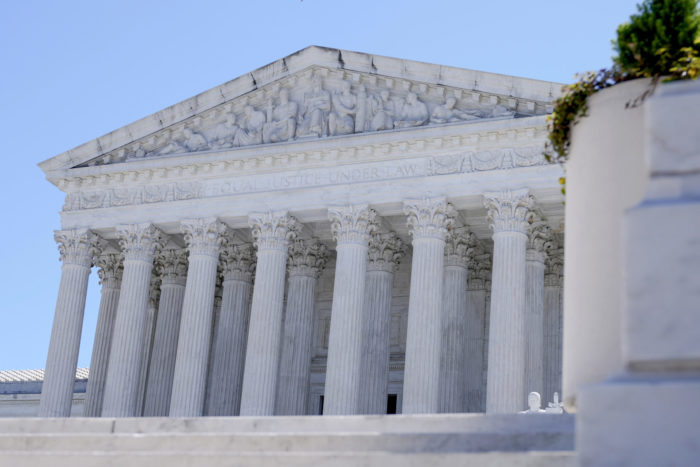
The U.S. Supreme Court, in a 6–3 decision on Friday, temporarily allowed the Trump administration to use a federal database to help verify whether voters are eligible to participate in elections, according to reporting by Andrew Rice at The Center Square.
What the program does
The Center Square reports that in March 2025, President Donald Trump signed an executive order directing the Department of Homeland Security to allow state and local authorities to verify the citizenship of registered voters and people attempting to register. DHS then revamped its Systematic Alien Verification for Entitlements (SAVE) program to monitor whether individuals are eligible to vote in local, state, and federal elections. According to the report, the program uses Social Security numbers, date of birth, and other identifying information to determine whether an individual is eligible to vote or must be removed from voter rolls.
Privacy challenge and the majority’s view
The League of Women Voters argued the program violated confidentiality and privacy protections by allowing DHS to access Social Security numbers of individuals on the list, The Center Square reported. The majority disagreed. “Congress, however, separately and expressly authorized DHS to request and receive information relating to citizenship and immigration status from other agencies, including [the Social Security Administration],” the majority wrote, as quoted by The Center Square. The majority also asserted that “The Federal Government has an obligation to respond to requests from state and local election officials seeking to verify the citizenship of voters.”
Dissent’s warning
Justices Ketanji Brown Jackson, Elena Kagan, and Sonia Sotomayor dissented. Jackson argued that laws allowing the Social Security Administration to share information place strict limits on how it can be used across the federal government due to privacy concerns. “There is no reason to believe that Congress meant to repeal laws that would otherwise prohibit federal agencies from disclosing citizenship information,” Jackson wrote in the dissent, as quoted by The Center Square. She also warned that the program could be used to revoke citizens’ voter registration and wrote: “In my view, however, the harm caused by burdening or disenfranchising even a few lawful voters outweighs the nonexistent harm that the Government experiences when it is prevented from taking an action that it likely lacks the authority to take.”
Temporary order
The Center Square characterized the ruling as a temporary allowance. Details such as the case name, schedule, or next steps were not included in the report.